When I talk to prospective homebuyers in Springfield, one of the most common concerns I hear is understanding what their actual monthly housing payment will be. Most people focus solely on the mortgage amount, but the truth is, your monthly payment is much more complex than that. Think of it like training for a marathon—you wouldn't just focus on the running pace without considering nutrition, recovery, and proper pacing. Similarly, buying a home requires understanding every financial component that goes into your payment.
Let me break down exactly what's included in that mortgage payment you'll be making for the next 15 to 30 years.
The Principal and Interest: The Foundation
Principal is the amount of money you borrowed to buy your house, or the amount of the loan that you have not yet repaid. This is the starting point for your payment calculation. If you're looking at a $400,000 home with a 20% down payment, your loan amount would be $320,000.
A $400,000 mortgage at 7% costs roughly $2,661 per month in principal and interest on a standard 30-year term. That sounds straightforward, but it's just the beginning. Interest is what you pay the lender for borrowing their money, and it varies based on current market rates and your personal financial profile.
Property Taxes: A Location-Specific Variable
Here's where things get interesting for Springfield homebuyers. Your county's rate creates the biggest swing. Property taxes are calculated by your local government based on your home's assessed value. A 1.5% tax rate on a $500,000 home adds $625 per month to escrow, while a 0.5% rate in a lower-tax state adds only $208. As your local real estate expert in Springfield, I can help you understand exactly what tax rates to expect in different neighborhoods throughout Greene County.
Homeowners Insurance: Protecting Your Investment
Annual premiums typically range from $1,200 to $3,000 depending on location, coverage limits, and property type. That translates to roughly $100 to $250 per month as a starting point, though your actual cost depends on factors like the age of the home, its construction type, and your coverage choices. This is another area where working with a knowledgeable agent makes a difference—understanding the insurance costs for different Springfield properties helps you budget more accurately.
Private Mortgage Insurance: When Your Down Payment is Less Than 20%
If you're putting down less than 20%, expect to pay PMI. Putting less than 20% down triggers PMI, which typically runs 0.5% to 1.5% of the original loan amount per year. On a $320,000 loan, that could add $133 to $400 monthly. The good news? The federal government reinstated the private mortgage insurance (PMI) tax deduction for 2026. That means the majority of homeowners who pay mortgage insurance for Conventional and government-backed loans may be able to write off those premiums when they file their tax returns in 2027.
The Affordability Rule of Thumb
Before we go further, let's talk about what you should actually be spending. The 28/36 rule is the standard underwriting guideline used by most mortgage lenders. "28" means your monthly housing costs should not exceed 28% of your gross monthly income. "36" means your total monthly debt payments (housing + all other debts) should not exceed 36%.
Let's use a realistic example. If your gross monthly income is $5,000, your housing costs should stay under $1,400 per month. This guideline helps ensure you're not overextending yourself financially.
What Your Total Monthly Payment Might Look Like
Most borrowers with this loan size land between $3,200 and $3,500 per month for the full housing payment. This includes principal, interest, property taxes, homeowners insurance, and potentially PMI. But remember, this doesn't account for everything you'll pay as a homeowner.
Budget 1% to 2% of the home's value annually for upkeep, which adds $333 to $667 per month on a $400,000 property. Additionally, HOA fees in planned communities commonly run $150 to $400 monthly beyond what any calculator shows. These are real costs that need to fit into your overall financial picture.
Don't Forget Closing Costs
Before you even make that first monthly payment, there's another hurdle: closing costs. In 2026, the average homebuyer pays between $6,000-15,000 in closing costs, depending on the home price, location, and loan type. More specifically, closing costs usually range from 3% to 6% of the loan amount, which means $6,000 to $12,000 on a $200,000 mortgage.
Closing costs are the expenses incurred at the finalization of your mortgage, separate from your down payment and necessary to complete the home purchase. They encompass various fees such as loan origination, underwriting, real estate agent commissions, home appraisal, title searches, closing attorney fees, insurance premiums, property taxes, credit report charges, and other transaction-related expenses.
This is a significant expense, so budget accordingly. Some of these costs may be negotiable, and in certain situations, you might ask the seller to contribute toward your closing costs.
Understanding Your Complete Payment Breakdown
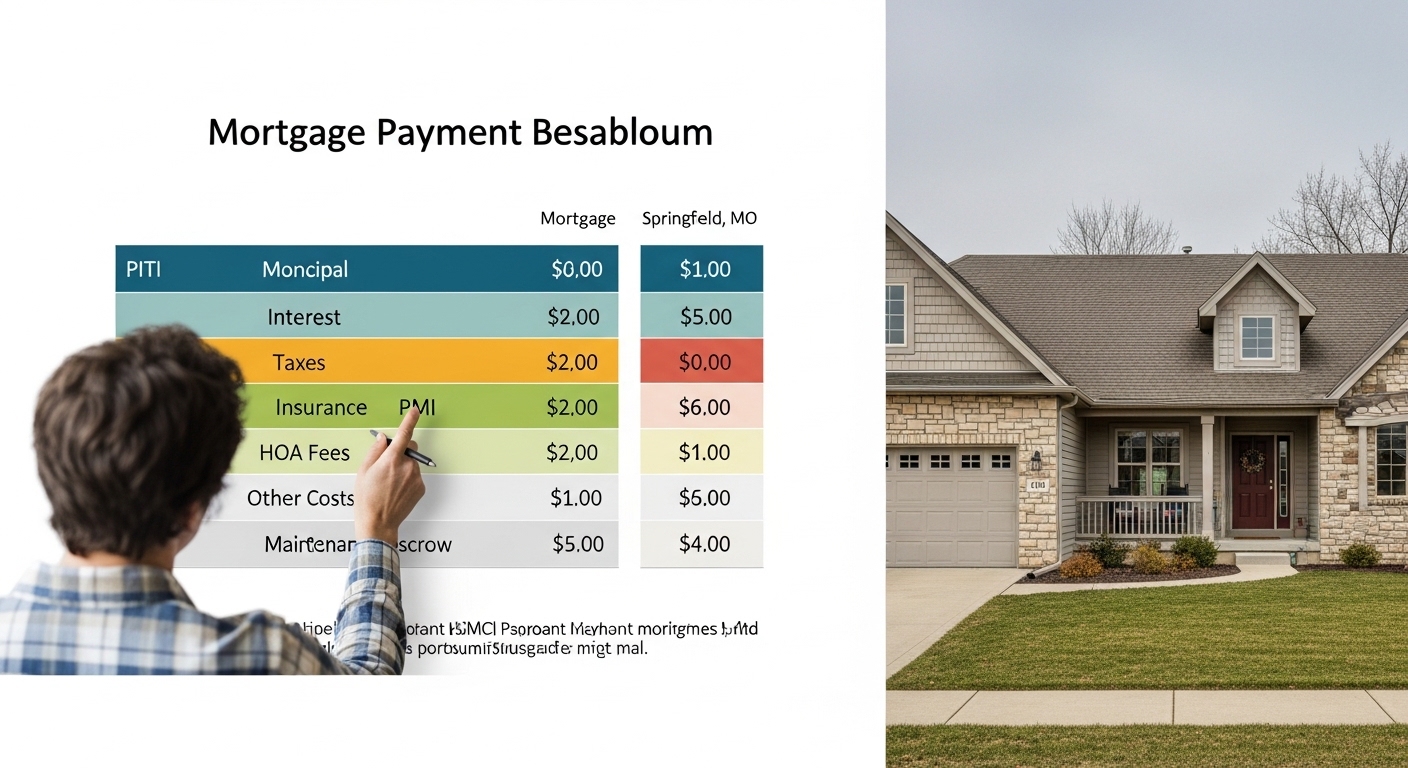
There are seven costs generally reflected in your monthly mortgage payment: principal, interest, escrow, taxes, homeowners insurance, mortgage insurance, and homeowners association or condominium fees. By understanding each component, you're better equipped to make informed decisions about the homes you can afford in Springfield.
Getting Professional Guidance
This is where I come in as your local real estate expert. Mortgage calculations can feel overwhelming, but breaking them down makes them manageable. I help Springfield buyers understand not just what they can afford, but what makes financial sense for their unique situation.
When you're working with me, I can help you explore properties at different price points and show you exactly what the monthly payments would be. I'll connect you with trusted lenders who can provide accurate quotes, help you understand the different loan programs available, and ensure you're not surprised by any costs at the closing table.
Just like preparing for a marathon requires a solid training plan, buying a home requires a solid financial plan. Start by getting pre-approved so you understand your budget. Then, when you're ready to explore properties in Springfield, search on HOUSEJET to find homes that fit your needs and budget.
Your path to homeownership doesn't need to feel overwhelming. With the right information and the right real estate agent in your corner, you'll have the confidence to make decisions that work for your financial health. Ready to take the next step? Let's talk about your home buying goals and create a plan that works for you.